Course Outline
← ChE 555: Applied Mathematics & Modeling for Chemical Engineers
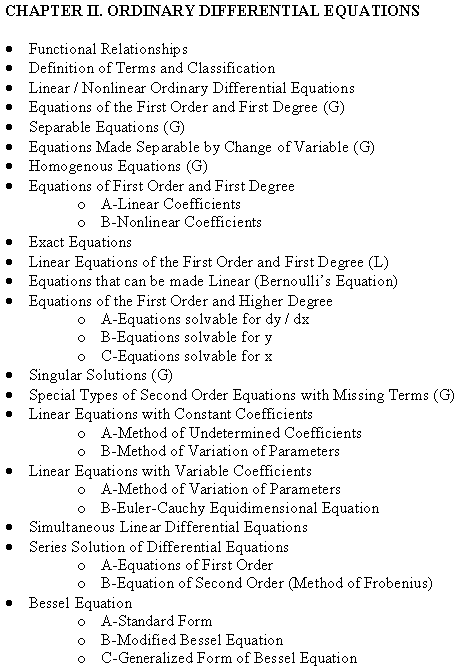
- ChE 555 Modeling & Analysis of Chemical Engineering Systems Course Outline Fall Semester 2002 / 2003 1999-2001 Catalog Data: ChE 555: Modeling and Analysis of Chemical Engineering Systems. Credit 2+2+0 = 3. Modeling and mathematical formulation of lumped-parameter and distributed-parameter systems encountered in chemical engineering. Review of analytical and numerical methods used in the solution of ordinary and partial differential equations. Goals: This course is designed to give graduates/seniors in chemical engineering the ability to develop mathematical formulation, to derive analytical solution, and to obtain numerical solution of steady-state and unsteady-state problems related to chemical engineering systems. Instructor: Prof. Dr. Uğur Akman Textbook: R.G. Rice and D.D. Do, Applied Mathematics and Modeling for Chemical Engineers, John Wiley & Sons, 1994, 706 pages, ISBN: 0-471-30377-1 + photocopies of instructor's notes. Applied Mathematics and Modeling for Chemical Engineers Richard G. Rice (Louisiana State Univ.) Duong D. Do (Univ. of Queensland, St. Lucia, Australia) ISBN: 0-471-30377-1 Formulation of Physicochemical Problems. Solution Techniques for Models Yielding Ordinary Differential Equations (ODE). Series Solution Methods and Special Functions. Integral Functions. Staged-Process Models: The Calculus of Finite Differences. Approximate Solution Methods for ODE: Perturbation Methods. Numerical Solution Methods (Initial Value Problems). Approximate Methods for Boundary Value Problems: Weighted Residuals. Introduction to Complex Variables and Laplace Transforms. Solution Techniques for Models Producing PDEs. Transform Methods for Linear PDEs. Approximate and Numerical Solution Methods for PDEs. Appendices. Nomenclature. Postface. Index. Reference Textbooks: Mickley M.S., Sherwood T.K., Reed C.E., Applied Mathematics in Chemical Engineering, McGraw-Hill, 1957 Chapter 3, pp.105-133 Chapter 4, pp.134-162 Chapter 5, pp.163-203 Chapter 6, pp.204-251 Chapter 7, pp.252-280 Chapter 8, pp.281-319 Jenson V.G., Jeffreys G.V., Mathematical Methods in Chemical Engineering, Academic Press, 1977 Chapter 2, pp. 25- 75 Chapter 3, pp. 76-114 Chapter 4, pp.115-142 Chapter 6, pp.154-186 Chapter 8, pp.241-307 Problems, pp.549-576 Franks R.G.E., Modeling and Simulation in Chemical Engineering, John-Wiley, 1972 Ayres Jr. F., Differential Equations, Schaum's Outline Series, McGraw-Hill, 1952 Spiegel M.R., Mathematical Handbook of Formulas and Tables, Schaum's Outline Series, McGraw-Hill, 1968 Luyben W.L., Process Modeling, Simulation, and Control for Chemical Engineers, McGraw-Hill, 1990 Friedly J.C., Dynamic Behavior of Processes, Prentice-Hall, 1972 Rhee H.-K., Aris R., Amundsen N.R., First Order Partial Differential Equations: Vol.I Theory and Applications of Single Equations, Prentice-Hall, 1986 Courant R., Hilbert D., Methods of Mathematical Physics Vol.II, John-Wiley, 1962 Aris R., Amundson N.R., Mathematical Methods in Chemical Engineering Vol.II, Prentice-Hall, 1973 Slattery J.C., Momentum, Energy, and Mass Transfer in Continua, McGraw-Hill, 1972 Bird R.B., Steward W.E., Lightfoot E.N., Transport Phenomena, John-Wiley, 1960 Churchill R.V., Operational Mathematics, McGraw-Hill, 1958 Carslaw H.S., Jeager J.C., Conduction of Heat in Solids, Oxford Univ. Press, 1959 Seinfeld J.H., Lapidus L., Mathematical Methods in Chemical Engineering Vol.III Process Modeling, Estimation, and Identification, Prentice-Hall, 1974 Prerequisites: differential equations; momentum, heat, and mass transfer Topics: Instructor's Notes - Textbook Comparison Table 0. ALGEBRAIC EQUATIONS: review of matrix algebra; solution of linear and nonlinear set of algebraic equations; internet resources (3 classes) 1. MATHEMATICAL MODELING: lumped- and distributed-parameter systems, shell balances (6 classes) 2. ORDINARY DIFFERENTIAL EQUATIONS: separable, homogeneous, and exact equations; singular solutions; linear equations with constant coefficients; linear equations with variable coefficients; simultaneous linear differential equations; series solution of differential equations; Bessel equations; numerical solution of ordinary differential equations, initial-value and boundary-value problems (15 classes) >>> Click here to see the detailed sections in ODEs. 3. PARTIAL DIFFERENTIAL EQUATIONS: classification; boundary conditions; method of combination of variables; orthogonality of functions, method of separation of variables; method of Laplace transforms, method of residues; numerical solution of partial differential equations, explicit/implicit finite-difference methods, method of lines, collocation methods (18 classes) Computer Usage: use of FORTRAN, EXCEL with Visual Basic Application (VBA) programming, MATLAB, MAPLE, MATHEMATICA, and MATHCAD in solution of ordinary- and partial-differential equation models in homework and project assignments. Grading: Approximate breakdown is as follows (may vary by e.g., ± 10%): Exam I ........ 20% Exam II ....... 20% Final Exam .... 20% Homework ...... 20% Geometric Average ! Project ....... 20% ___________________ 100%
- Applied Mathematics and Modeling for Chemical Engineers Richard G. Rice (Louisiana State Univ.) Duong D. Do (Univ. of Queensland, St. Lucia, Australia) ISBN: 0-471-30377-1
- Formulation of Physicochemical Problems. Solution Techniques for Models Yielding Ordinary Differential Equations (ODE). Series Solution Methods and Special Functions. Integral Functions. Staged-Process Models: The Calculus of Finite Differences. Approximate Solution Methods for ODE: Perturbation Methods. Numerical Solution Methods (Initial Value Problems). Approximate Methods for Boundary Value Problems: Weighted Residuals. Introduction to Complex Variables and Laplace Transforms. Solution Techniques for Models Producing PDEs. Transform Methods for Linear PDEs. Approximate and Numerical Solution Methods for PDEs. Appendices. Nomenclature. Postface. Index.